

We started Political Science in class this year – going over what they done last year.
The first exercise they did was to reflect on what they liked about India and what they would change if they had the power. The idea of this exercise was to get them to own the change they wanted to make. Maybe spark a fire.
The visions were grand. One wanted to protect fish. Another said she would build structured cities. A third said she would make sure that housing complexes came up around the lakes and forests and not by destroying them. Will not do anything adds to climate change was one more. Will create jobs and erase poverty stated another who said he liked India because it was now a powerful economy.
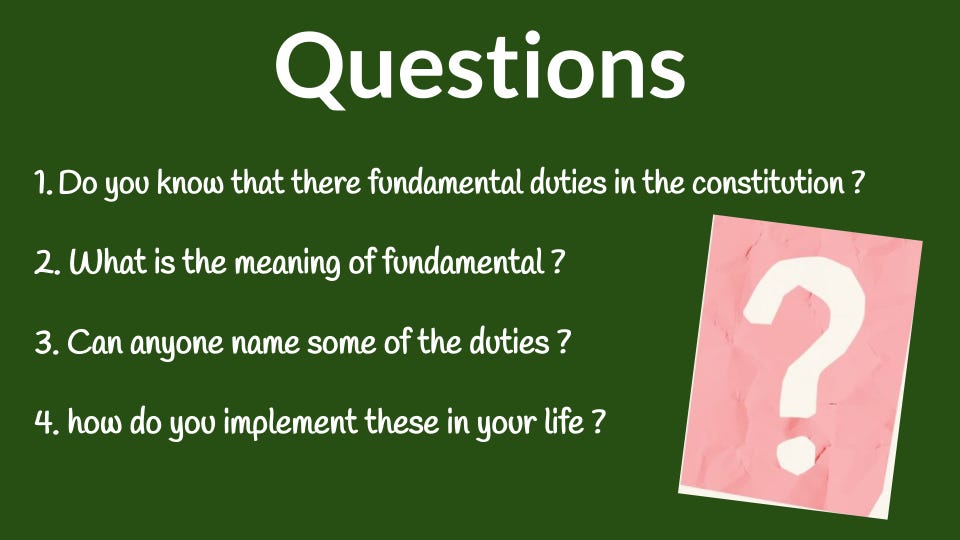
Then they read the Fundamental Duties – Article 51A of the constitution.
Each picked up a fundamental duty and reflected on why they thought that resonated with them. One picked a duty because it said don’t do acts that are defamatory to women – she felt that crime against women was reported in the news papers every day and it bothered her. It had to become a fundamental duty.
As we were studying these and presenting to the class, several interesting discussions arose. “Are these duties enforceable by law or are they just a mindset?” was a question one of the learners asked. This sparked a discussion on whether mindset can be inculcated and how? Some said it could not be after a period of time. Another argued it could because even though a few business men for example just worked for profits there were organizations like ISRO where the scientists were aware that they could make or break the reputation of the country. Our men in uniform would readily sacrifice their lives for the country.
Then we saw how every job can be done keeping in mind duties to the place of work or keeping the country in mind.
For example a teacher could be punctual because her employers kept track of time or she could keep in mind that she is a role model to the future citizens of the country and strive for excellence.
So then if all the citizens kept the country in mind, the country would automatically thrive. So we decided to do a survey on how well the fundamental duties have been inculcated.
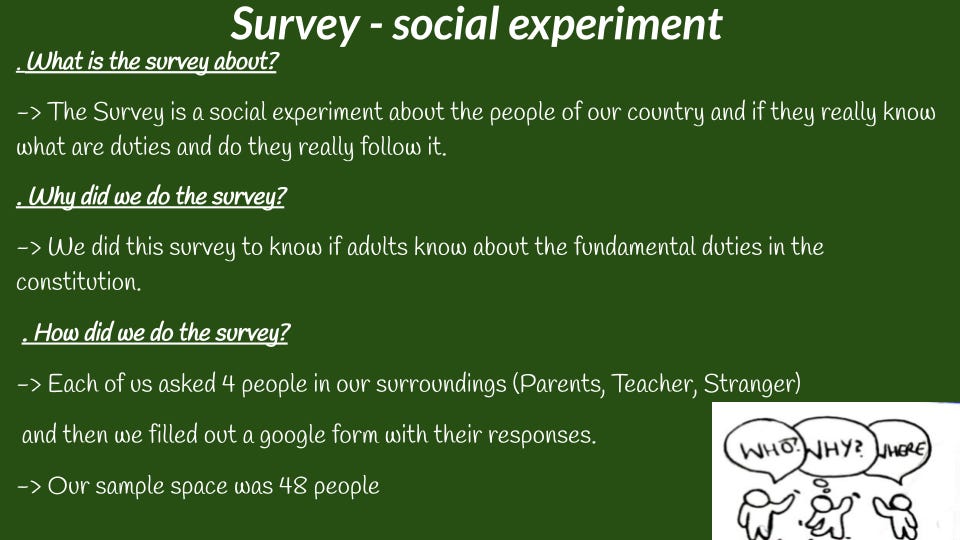
The children interviewed the adults around them. They each interviewed their parents, a teacher and a stranger.
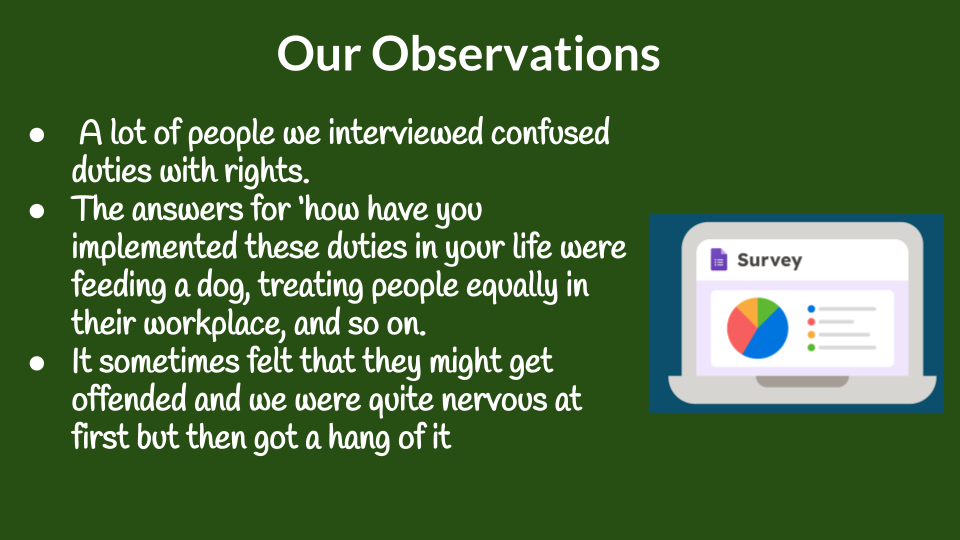
They then tabulated the results from 48 respondents and presented their experience to their juniors, seniors and teachers in School in the school assembly. It was an amazing interactive session where they first explained the duties and then the results.
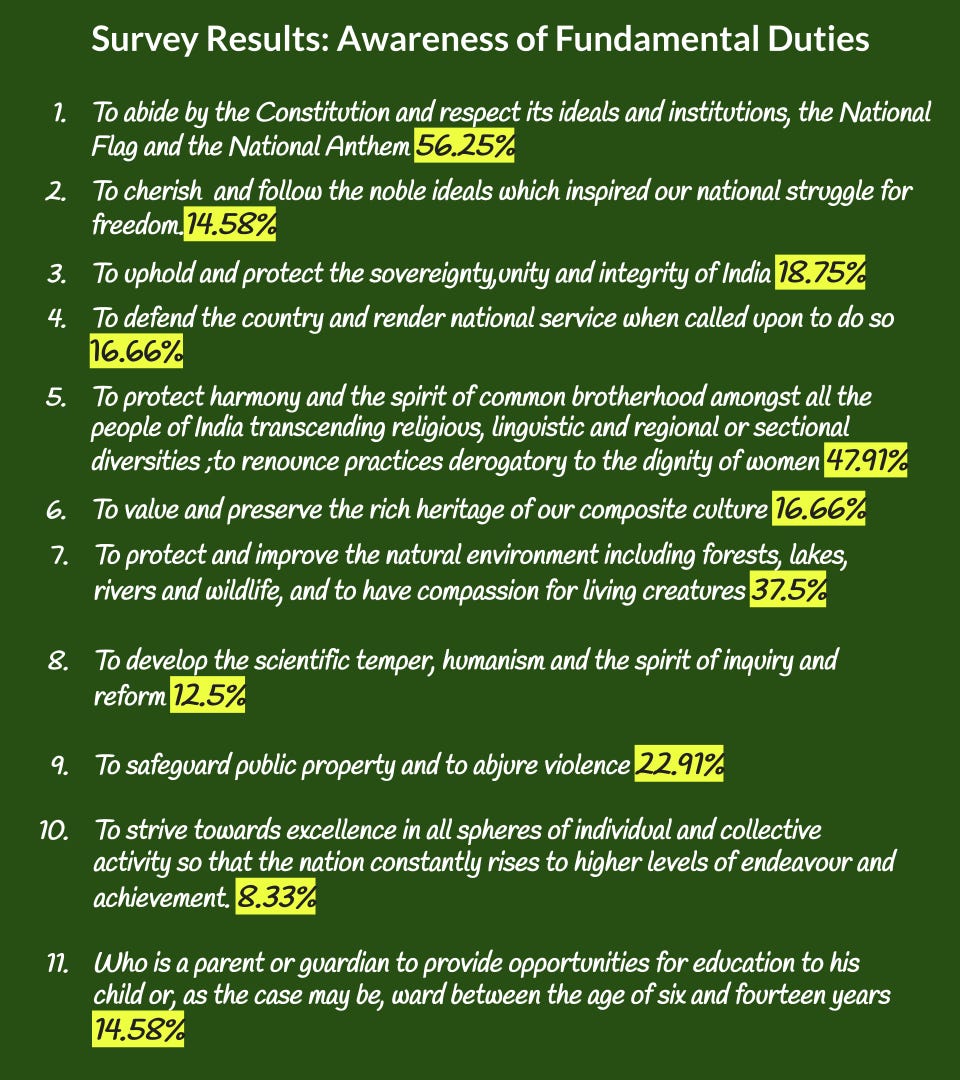
The Graphical representation of the survey results
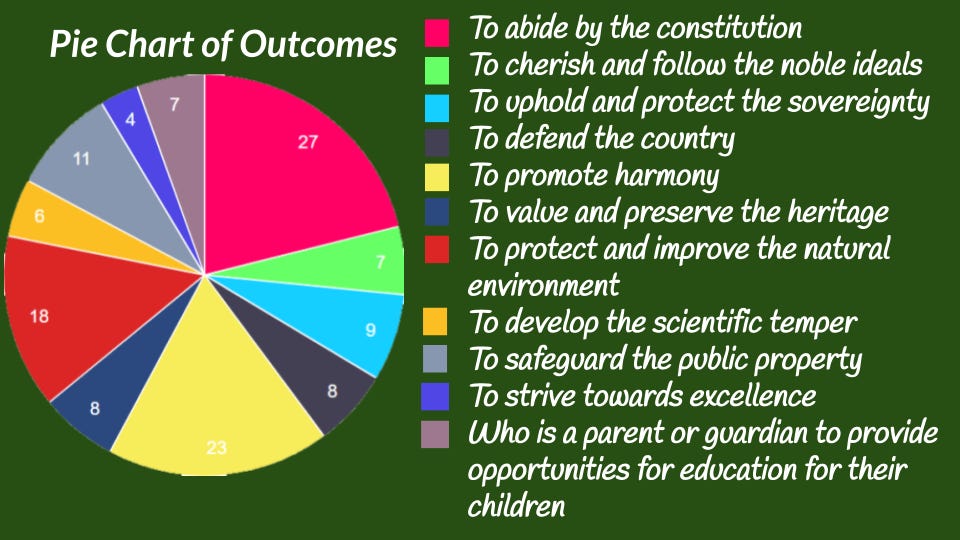
The results of the survey were interesting. Most said they had to abide by the constitution and promote harmony. The least known duty was the striving for excellence. The promotion of scientific enquiry but at the same time humanism provoked a very interesting discussion with the science facilitators. Most were also not aware of our duty to preserve heritage. The presentation to the school was very interactive. It actually provoked many of us facilitators to think how we could actually inculcate these values on a daily basis. Can we for example hold a workshop where the learners draw it up themselves was one thought. They could deep dive into each and ask questions on what it meant for them. For us this was a successful experiment to try and facilitate political science using the critical thinking methods used in our Global Perspectives Curriculum.
Check out the final presentation the children prepared by clicking here.
(Please swipe to go to the next/previous, zoom for a clearer view)
Such an amazing exercise. One that will stay forever with the learners and those whom they interviewed.